Interactive noise color guide
White vs pink vs brown noise
White, pink, and brown noise use the same kind of random signal with different frequency balances. Hear all three, compare the frequency chart, and choose the sound that feels least distracting at a low, comfortable volume.
Open the playerHear white, pink, and brown noise side by side
Select a noise color, press play, and switch while the audio is running. The generator creates each signal live in your browser, so you can compare them without a repeating recording or a separate audio download.
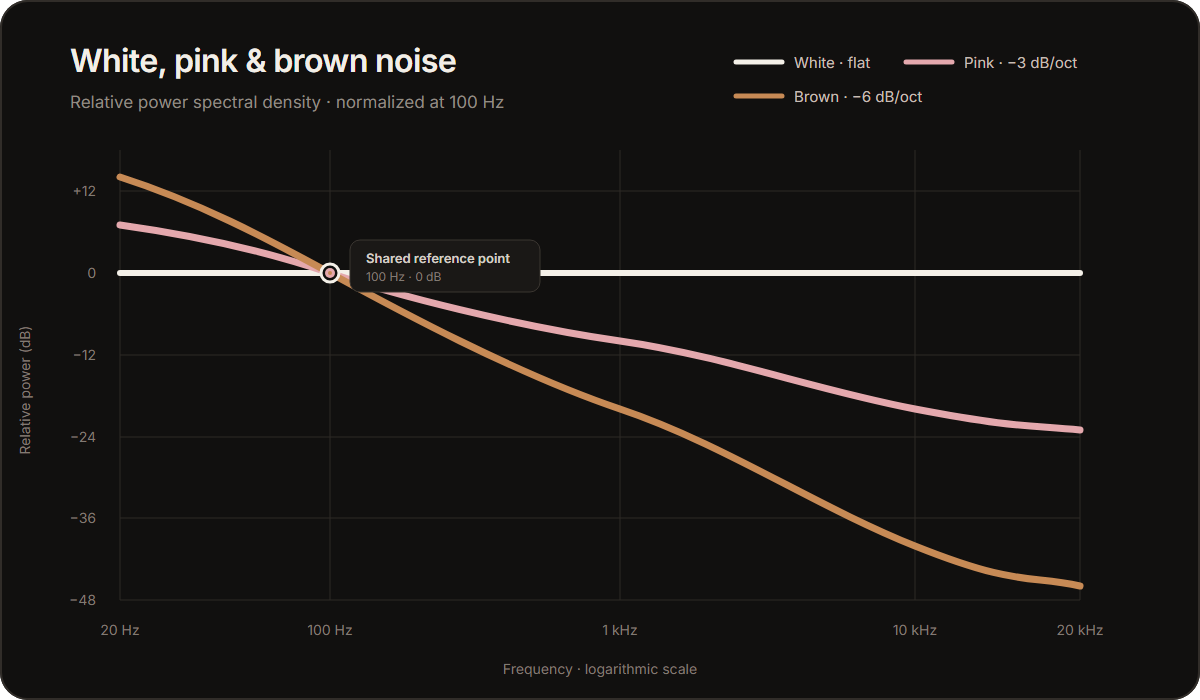
White, pink, and brown noise comparison chart
The main difference is spectral slope: how quickly power decreases as frequency rises. The chart is normalized at 100 Hz to make the three shapes easy to compare; it describes frequency balance, not playback volume.
White noise vs pink noise
White noise has broadly equal power in each hertz of bandwidth, which gives it a bright, detailed hiss. Pink noise loses about 3 dB per octave as frequency rises, reducing the high-frequency edge and placing relatively more weight in the lower octaves. If white noise sounds sharp, pink noise is the natural next comparison.
Try the white noise generator or the pink noise generator at the same device volume.
Pink noise vs brown noise
Pink noise falls about 3 dB per octave; brown noise falls about 6 dB per octave. Brown therefore removes more high-frequency energy and sounds deeper and more rumbling. Pink keeps more midrange detail, while brown can feel smoother on headphones or speakers that reproduce low frequencies well.
Compare the pink noise generator with the brown noise generator.
Which noise color is best for sleep?
There is no proven universal winner. A 2021 systematic review found mixed results and rated the available evidence for continuous noise as very low quality. A 2026 laboratory pilot found that pink noise reduced some effects of traffic noise, but it did not improve quiet-night sleep and could feel tiring to some listeners. Treat noise color as a comfort and masking choice, not a treatment.
- Set your phone or speaker to a low, comfortable level.
- Listen to white, pink, and brown noise for a few minutes each.
- Choose the one that makes changes in your surroundings least noticeable without drawing attention to itself.
- Stop or lower the volume if the sound feels uncomfortable.
Sources: 2021 systematic review and 2026 laboratory pilot.
How this noise generator makes each color
The player begins with continuously generated random samples. White noise uses the broad signal directly, pink noise applies a multi-pole filter that approximates a 1/f power spectrum, and brown noise uses a leak-controlled integrator plus DC blocking for a steeper low-frequency-weighted spectrum. Sound changes use a smooth crossfade, and the analyzer reads only the outgoing digital signal—not your microphone.
Speaker size, room acoustics, and hearing all affect the result. Use the Warmer/Bright and Deep/Light controls on each generator to adapt the sound without changing the underlying noise color.